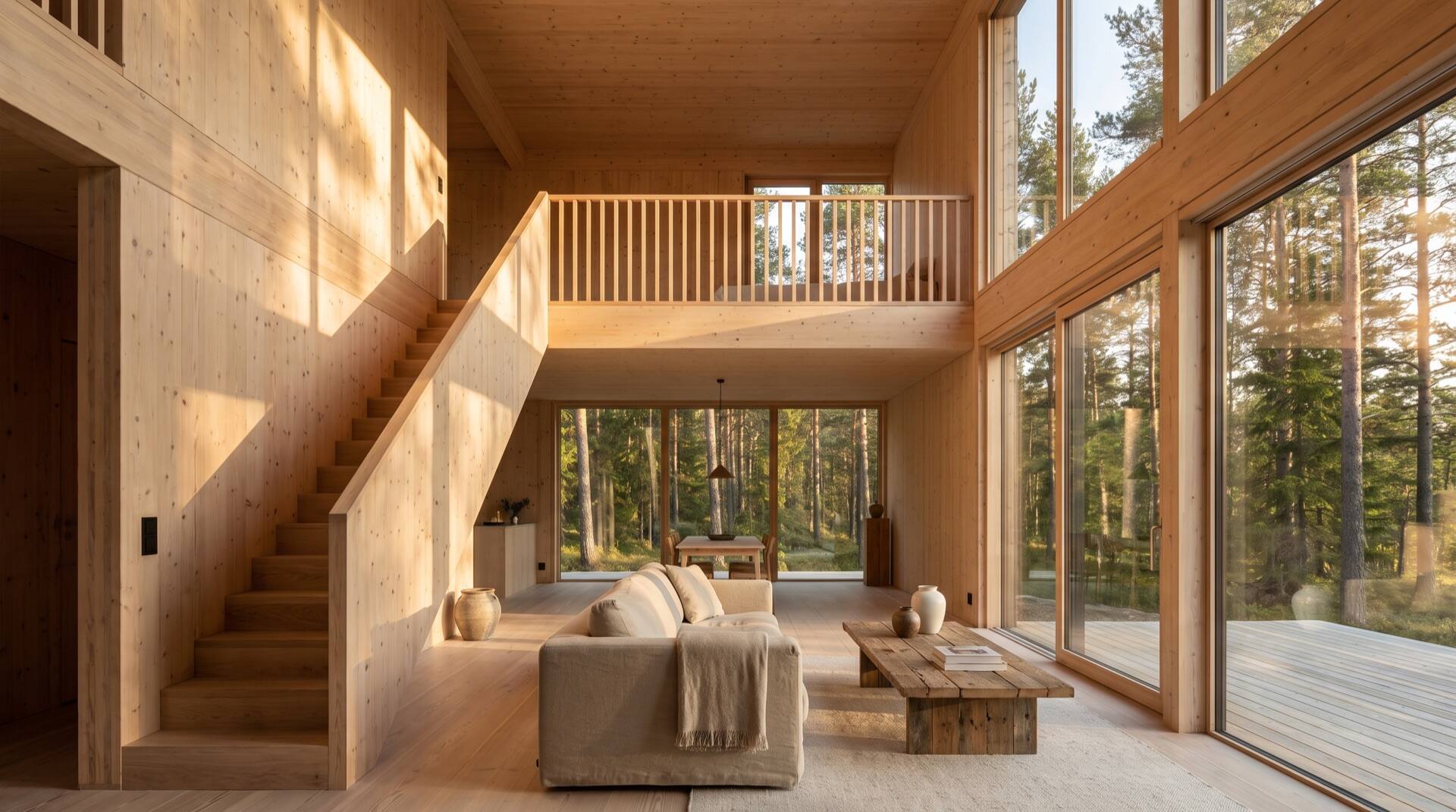
Building with CLT: a complete guide for architects and developers
CLT (Cross-Laminated Timber) is becoming the material of choice for modern construction across the EU and North America. This guide explains why, where it's used and how to work out the economics.
CLT in 2026: why mass timber, why now
CLT is a solid panel of cross-glued lamellas — 99% timber, 1% adhesive. That layup delivers structural strength once reserved for concrete or steel, at a fraction of the weight. Why now:
- Height at scale. Timber buildings of 18+ storeys already stand — Brock Commons (Vancouver), Dalston Lane (London), HoHo Wien (Vienna).
- Carbon storage. Timber locks up CO₂ for the life of the building, while cement production is one of the largest sources of industrial emissions.
- Speed. Panels arrive on site cut to size — erection is 30–40% faster than cast-in-place reinforced concrete.
- Ukraine. Rezult CLT is the first Ukrainian producer (since 2020), part of the Rezult wood-processing group, so a project no longer depends on imported panels.
CLT vs concrete vs brick — a detailed comparison
Materials should be compared not by price per tonne, but by how they behave in the structure and on site.
| Parameter | CLT | Cast-in-place concrete | Brick / block |
|---|---|---|---|
| Structural weight | ≈6× lighter than concrete | Heavy → massive foundation | Heavy |
| Build speed | 30–40% faster (factory-ready) | Slow (formwork, curing) | Slow (wet processes) |
| Carbon footprint | Stores CO₂ | High cement emissions | High (firing) |
| Precision & stability | Factory-set, 0.15% shrinkage | Depends on the site | Depends on the laying |
| On-site waste | Minimal (panels cut to size) | Significant | Significant |
| Seismic behaviour | Light and resilient (EN 1998-1) | Rigid, heavy | Brittle |
The technical basis for the comparison — layup, strength grade up to C24, REI 60 fire rating, sound insulation up to Rw 58 dB — is on the Rezult CLT panels page.
What a CLT building costs — how to work it out
The common mistake is comparing CLT and concrete “per m²” at the shell stage. The right model is lifecycle cost:
- Material. Price depends on layup, thickness and panel format — quoted for the specific project, not from a “per m³” price list.
- Erection. Lower, thanks to factory readiness: fewer people, less plant and less time on site.
- Foundation. A lighter structure means less concrete in the base.
- Operation. High thermal insulation cuts heating bills across the building's life.
We don't quote a “price per m²” without a project — send us a layout and Rezult CLT will prepare the panel layup, load-bearing calculation and a CE-ready specification with an indicative budget range.
CLT for housing reconstruction
Modular CLT construction is one of the priority routes for fast reconstruction. What it offers for rebuilding:
- Factory readiness = minimal on-site processes and a shorter cycle.
- Less raw material on site — lower risk of theft and downtime.
- Production inside the country (Rezult CLT, Korosten) — no dependence on imports or cross-border logistics.
- Alignment with specifications such as the EU DRF and “Grain from Ukraine”-type timber-construction initiatives.
Frequently asked questions
How many storeys can you build with CLT?
Up to 18 storeys depending on national building codes. Buildings of 18+ storeys already stand worldwide — Brock Commons in Vancouver, HoHo Wien in Vienna. Rezult CLT holds ETA-21/0914 with load-bearing calculations to Eurocode 5.
Is CLT more expensive than concrete?
The material may cost more per m³, but the right basis is lifecycle cost: factory-ready panels cut schedules by 30–40%, the lighter structure reduces the foundation, and energy efficiency lowers running costs.
Does CLT burn?
Mass timber behaves predictably: the outer layer chars at 0.65 mm/min and protects the load-bearing core. Assemblies based on Rezult CLT achieve an REI 60 fire-resistance rating.
Is CLT produced in Ukraine?
Yes. Rezult CLT is the first and only cross-laminated timber producer in Ukraine, since 2020. The plant in Korosten runs a Ledinek X-Press line, panels up to 3.5×18 m, ETA-21/0914 + CE.